
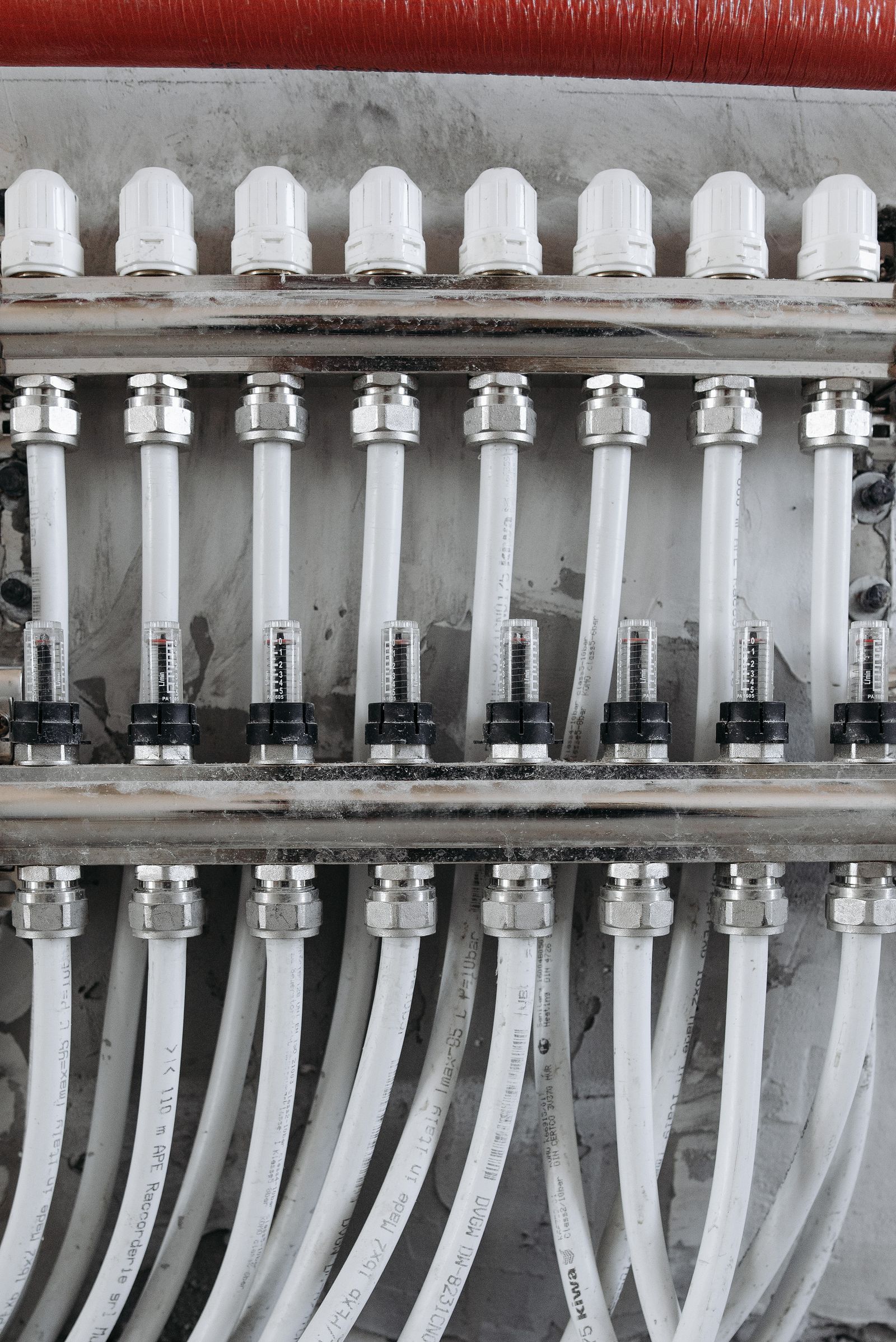
Ask anyone who has it: there's no heat like a warm floor on a January morning. Radiant floor heating circulates warm water through tubing embedded in or under your floors, and the floor itself becomes the radiator. Even, silent heat rising exactly where you live. No vents, no drafts, no dust blowing around, no cold tile under bare feet.
We install hydronic radiant floor systems in new construction and major remodels across Fort Collins, from single-room additions to whole-house installations. We also service existing radiant systems.
Warm floors start here: call (970) 555-0100 to request a quote, or check availability online.
How radiant floor heating works
Cross-linked polyethylene (PEX) tubing loops through the floor assembly — embedded in a concrete slab, stapled under a subfloor with heat transfer plates, or set into a thin overpour on an existing slab. A boiler or water heater heats the water to a modest 100–140°F (far cooler than baseboard systems need), and a manifold with zone valves or individual circulators distributes it loop by loop. Each zone gets its own thermostat.
Because the heat source is the entire floor surface, the system runs at low water temperatures — which makes it exceptionally efficient, especially paired with a condensing boiler or heat pump that loves low-temp operation.
New construction vs. retrofit
- New builds and additions: the ideal case. Tubing goes in before the slab is poured or the subfloor goes down; it's simply part of construction. This is the most cost-effective way to get radiant, and it's popular in the custom homes going up around Fort Collins.
- Slab-on-grade retrofits: tubing can be set in a thin concrete overpour on top of the existing slab. You lose an inch or so of ceiling height and need to manage transitions at doors, but it works.
- Above-subfloor retrofits: low-profile panel systems sit on top of the existing floor with tubing channels, then get covered by the finished floor. Higher material cost, minimal demolition.
- Underfloor (staple-up): tubing stapled beneath the subfloor between joists, with aluminum transfer plates. No floor height change, but output is lower — best for supplemental heat or mild zones rather than primary heating in our climate.
We'll tell you honestly which approaches fit your project. Radiant is wonderful, but it's not the answer for every remodel. Sometimes mini-splits or baseboards make more sense, and we'll say so.
Zones, controls, and floor coverings
Radiant zones by nature: the manifold makes it easy to give the master suite, the great room, and the basement each their own thermostat. Bathrooms get their own small zone so the tile is always warm. Controls range from simple thermostats to smart systems with floor sensors that cap the surface temperature.
Floor covering matters: tile and stone conduct heat beautifully and are the ideal pairing. Engineered wood works with temperature limits. Carpet insulates against the heat. Thick carpet and pad can cut output significantly, so we plan around your flooring choices before tubing goes in.
The heat source
Radiant needs warm water from something: a boiler (the classic pairing — see Boiler Services), a high-efficiency water heater for smaller systems, or an air-to-water heat pump for the efficiency-minded. Condensing boilers are the sweet spot. Radiant's low water temperatures let a condensing boiler stay in its most efficient mode almost constantly — something baseboard systems can't do.
Service for existing radiant systems
Already have radiant? We service it: manifold and zone valve diagnosis, circulator pump replacement, air elimination (gurgling zones mean trapped air), control upgrades, and boiler-side service. Uneven heating across zones usually traces to flow balance or a stuck valve. Both fixable.
What affects the cost of radiant floor heating
- Project type: new construction is the most economical; retrofits cost more per square foot.
- Square footage and zone count: more area and more zones mean more tubing, manifold capacity, and controls.
- Floor assembly: slab embed vs. overpour vs. panel system vs. staple-up.
- Heat source: new boiler vs. existing equipment vs. heat pump.
- Controls: basic thermostats vs. smart zoning with floor sensors.
Related services: Boiler Services, Mini-Split Systems, Smart Thermostats
Frequently Asked Questions
Can radiant floor heating be the only heat source in a Fort Collins home?
What flooring works best over radiant heat?
How long does radiant floor installation take?
Is radiant heating expensive to run?
Can you add radiant to just a bathroom or addition?
What maintenance does a radiant system need?
Call (970) 555-0100 for radiant floor heating in Fort Collins, CO. The most comfortable heat there is — done right from the tubing up.