
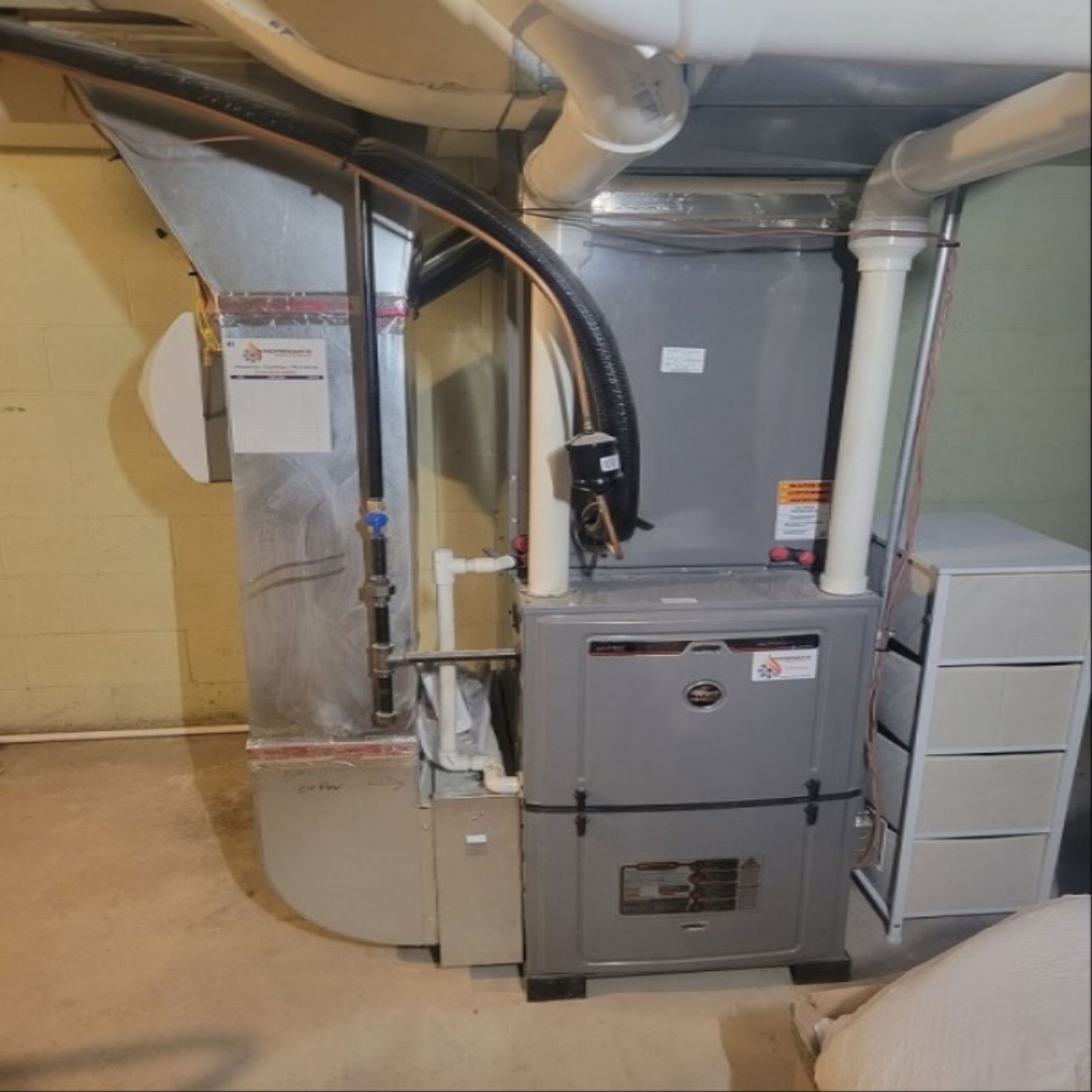
Your furnace is the hardest-working appliance in a Fort Collins home. It runs five to six months a year through sub-zero snaps, and when it dies in January, you find out fast how much you depended on it. A new furnace should be sized to your house, vented safely, and set up so it sips gas instead of gulping it. That's the job.
We install gas furnaces — the standard for Northern Colorado — and we size every one with a real load calculation. A furnace that's too big short-cycles itself to an early death. One that's too small never catches up on the coldest nights. Neither is acceptable.
Need a new furnace? Call (970) 555-0100 to request a quote, or check availability online.
Gas furnace efficiency: what AFUE means for you
AFUE — Annual Fuel Utilization Efficiency — tells you how much of your gas becomes heat (the U.S. Department of Energy defines it as the percentage of fuel a furnace converts into usable heat over a full heating year). An old 80% furnace wastes twenty cents of every dollar up the flue. A 95–98% condensing furnace keeps almost all of it. In Fort Collins, where the heating season is long, that gap shows up on every winter gas bill for the next fifteen to twenty years (the typical service life of a gas furnace per NAHB's life-expectancy study).
We walk you through the real math: the price difference between efficiency tiers versus your actual gas usage. For reference, ENERGY STAR data shows an ENERGY STAR furnace runs about 15% more efficiently than a conventional model, and Colorado sits in ENERGY STAR's Northern region, where newly certified gas furnaces must now meet 97% AFUE under the Version 5.0 standard. For a big, drafty older home, the high-efficiency unit often pays for itself. For a small, tight new build with modest heating bills, the mid-tier can be the smarter buy. We don't default to the most expensive box — we match the furnace to the house.
Sizing and fuel decisions
- Load calculation, every time. We measure the house — insulation, windows, air leakage, ceiling heights — and size the furnace to the actual heat loss. The City of Fort Collins requires equipment to be sized per ACCA Manual S, from loads calculated per ACCA Manual J — the industry's room-by-room heat-loss calculation. So a real load calculation isn't optional here; it's code. Our winter design temperature is −4°F at 5,001 feet of elevation, and we factor in the roughly 4%-per-1,000-foot altitude derating the National Fuel Gas Code calls for. Replacing "like for like" is how oversized furnaces happen; we don't do that.
- Single-stage, two-stage, or modulating. Single-stage is full-blast or off. Two-stage and modulating furnaces adjust their output to the weather, which means steadier temperatures and fewer cold spots on mild days. Fort Collins shoulder seasons — those 45-degree October days — are where staging really earns its keep.
- Gas vs. electric. Natural gas is the economical heat source for most Fort Collins homes. If your home is all-electric or off the gas main, a heat pump may make more sense than electric resistance heat. Ask us about Heat Pump Services.
- Venting. High-efficiency furnaces vent through PVC out a side wall; older 80% units use the chimney or a metal flue. Conversions need new venting and combustion air — we handle the whole thing to code.
Old Town and older homes: special considerations
A lot of Fort Collins still heats with furnaces installed in the 80s and 90s, some with the original ductwork. Replacing one of these isn't just a swap — it's a chance to fix twenty years of compromises. We check the flue for deterioration, verify combustion air requirements (tightened-up old houses sometimes starve their furnace of air), and inspect the ductwork for the leaks that made the old furnace work overtime. In some historic homes near Old Town, the mechanical room is tight enough that the new unit's footprint matters — we measure before we order.
What's included in our installation
- Home evaluation and load calculation. Measurements, ductwork inspection, gas line sizing check.
- Your quote. Equipment, labor, venting, permits, thermostat — one number, no surprises.
- Permits and inspection. We pull permits and meet the inspector.
- Old furnace removal. Disconnected, hauled away, recycled.
- New furnace set and vented. Leveled, secured, vented to code with proper slope on condensing drains.
- Gas, electrical, and duct connections. Pressure-tested gas line, new electrical whip, sealed duct transitions.
- Startup and combustion test. We fire it, verify the flame, check CO levels, and set blower speeds.
- Walkthrough. Thermostat programming, filter location, and what to expect the first week.
What This Costs in the Fort Collins Area
These are researched market ranges from national and Colorado-regional sources (HomeAdvisor's June 2026 cost data), NOT our prices — every home is different. Request a quote for your exact cost.
| Item | Market range | What drives the range |
|---|---|---|
| Furnace replacement (installed) | $2,823–$6,897 (most pay ~$4,814) | Fuel type + AFUE efficiency tier; BTU sizing (heating capacity) and home size |
| Full HVAC system (heating + cooling, installed) | $5,000–$12,500 (avg ~$7,500) | Whether heating and cooling are replaced together; equipment tiers |
What affects the cost of furnace installation
- Furnace size and AFUE rating: capacity and efficiency tier are the biggest drivers.
- Staging type: single-stage vs. two-stage vs. modulating.
- Venting changes: converting from chimney-vented to direct-vent adds work.
- Ductwork repairs: sealing or modifying ducts so the new furnace can actually deliver its heat.
- Gas line or electrical upgrades: if the existing lines can't feed the new unit.
- Permits and inspections: included in the quote.
Related services: Furnace Repair, AC Installation, Whole-Home Humidifiers
Frequently Asked Questions
How long does a furnace installation take?
What AFUE rating should I get in Fort Collins?
Can I replace just the furnace and keep my old AC?
Will a new furnace work with my existing thermostat?
Do high-efficiency furnaces need a drain?
What happens to my old furnace?
Call (970) 555-0100 for furnace installation in Fort Collins, CO. Sized right, vented safe, quoted straight.